Your brand is being discussed in millions of AI conversations right now, and you almost certainly are not measuring a single one of them.
Traditional analytics answer a narrow question: how many people came to your site and what did they do? They are silent on the bigger threat and opportunity of 2026—content that never sends a click. When a user asks ChatGPT or Perplexity "which marketing tool is best for small agencies," the model composes an answer from sources it trusts. If your brand appears in that answer, you won. If it does not, you are invisible in the fastest-growing channel on the web, and no analytics tool will ever tell you.
This guide explains what AI brand visibility is, why it matters, the methods and tools for measuring it, and how to convert the data into a KPI your organization will actually use.
Why Report Rankings Are Fading
For two decades, marketers equated visibility with keyword position. The mental model was simple: appear in the top ten URLs, earn the click, count it in the dashboard.
That model leaks on both ends now. Zero-click answers resolve more than half of informational queries without any website visit, so a page can win the answer and gain nothing measurable in GA4. Meanwhile AI-synthesized answers merge content from multiple sources—a definition from one domain, a statistic from another, a recommendation from a third—and attribute contributions in ways that never register as traffic.
The result is that your strongest media moment can be delivering the exact answer a model quotes to millions of users, with your only clue being a flat analytics line. Brands that keep optimizing only for clicks are gambling on a channel the audience is slowly leaving.
What AI Brand Visibility Looks Like
AI visibility has several distinct layers, and you should measure each separately:
Unprompted mentions. The model names your brand as part of its answer without you being cited as a source. This is the highest-value signal—it means the model treats you as the default answer.
Cited mentions with link. The model lists or links your site as a reference for a claim. Strongest form for traffic: the user can actually click through.
Cited mentions without link. Your content contributed but the model paraphrased it without a source link. Partial credit and easy to miss.
Preference share. How often the model chooses you versus competitors when a user asks "best X" style questions.
Sentiment and accuracy. Whether the model describes your product accurately, positively, or badly. A hallucinated comparison is a reputation problem before it is a KPI problem.
How to Track It: Practical Methods
No single tool measures everything, so a working stack layers general-purpose and signal-specific approaches.
Method 1: Manual AI query audits (free, weekly). Maintain a list of 20 to 40 of your highest-value discovery queries. Each week ask ChatGPT, Perplexity, Gemini, and Google AI Overviews, and record whether your brand was mentioned, cited, and how it was described. This is crude but it is the ground truth every other method measures against.
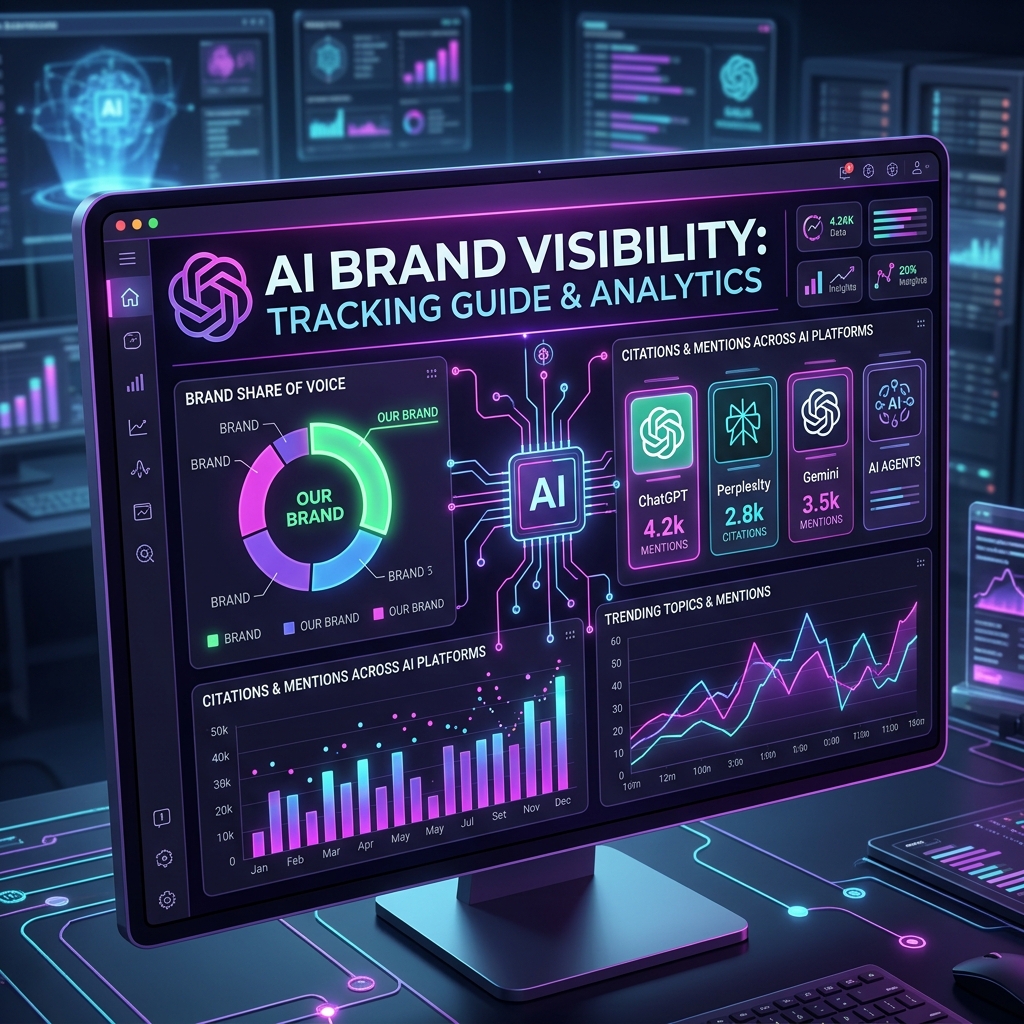
Method 2: Dedicated LLM visibility platforms. A fast-growing category of GEO tracking tools simulates AI responses at scale and reports your brand's share of citations and mentions across engines over time. They flag when a competitor is mentioned more often and surface the queries where you are losing. These tools turn the manual audit into a repeatable dashboard.
Method 3: Google Search Console and GA4 overlays. Query-level Search Console data still shows impressions even when clicks are near zero. A page with high impressions and no clicks is often being consumed by an AI overview—worth inspecting even without direct attribution.
Method 4: PR listening combined with AI search. Traditional media-monitoring tools capture where your brand is mentioned online, and those mentions feed the authority graph that models lean on. Track both the mention and whether it appears in engine answers downstream.
Method 5: Referral "AI traffic" segments. GA4 traffic now includes recognizable AI engine referrers. Segment sessions from ChatGPT, Perplexity, Gemini, and similar origins to see the direct click-through that does happen.
Turning the Data Into a Metric
Collecting measurements is easy; making them useful is not. Build an AI Visibility Score—a weighted composite of the layers above, normalized by your key query set.
A practical weekly formula: assign 10 points for a cited mention with link, 6 for a cited mention without, 4 for an unprompted brand mention, and 2 for a positive preference-share flip. Average across your query list, then compare against the prior period and against your top three competitors. Distribute the score in the same meeting where you review keyword rankings, so the conversation becomes "how are we visible everywhere search happens," not just "how are we visible on page one."
Data-Driven Insights
What the emerging measurements reveal about how AI participates in discovery:
- The attribution shift. In niche B2B queries, a meaningful minority of decision purchases now begin with an AI answer rather than a search engine result page. Brands absent from AI answers are missing the top of the funnel entirely.
- Concentration on a few sources. LLM answers in most categories draw repeatedly from a small set of frequently cited domains. Winning a place in that small set matters far more than being a frequent but unfavored contributor.
- Consistency beats bursts. Promotional spikes produce short-lived AI mentions; durable visibility correlates with a steady base of structured, authoritative, question-shaped content updated over months.
FAQ
How do I check if ChatGPT mentions my brand?
Run a manual query audit: paste your most important customer questions into ChatGPT, Perplexity, Gemini, and Google AI Overviews, then record whether your brand is mentioned, cited, and how it is described. Repeat weekly with the same query set and track changes over time.
What is an AI visibility score?
It is a weighted composite metric that summarizes your brand's presence in AI-generated answers—cited with link, cited without link, unprompted mention, and preference share—averaged across your key queries and compared with competitors and prior periods.
Which tools track brand mentions in AI engines?
Dedicated GEO and LLM-visibility platforms simulate AI responses at scale and report citation share and mentions across ChatGPT, Perplexity, Gemini, and others. They complement Google Search Console, which shows zero-click impressions, and GA4 referrer segments from AI engines.
Why does my brand not appear in AI answers?
AI models favor content that is easy to extract, clearly written, and reinforced by mentions on other trusted sources. If your pages are dense prose, your site is cite-light, or your brand rarely appears in industry publications, the model has little reason to attribute an answer to you.
Is AI visibility more important than SEO rankings?
They measure different things and both matter. Rankings determine who gets the click on Google's results page; AI visibility determines who is named in a synthesized answer, often without any click. For informational discovery in 2026, AI visibility is becoming the larger share of the funnel.
Conclusion
The days of measuring marketing success with a single ranking report are over. Audiences now discover brands through answers that never send visitors to your site, and the tools that told you about visits are silent on that entire channel. Start a weekly AI query audit, add a dedicated visibility tool as the data grows, and build an AI Visibility Score into every reporting cycle. The brands that will be chosen by both humans and models are the ones measuring both channels seriously, starting now.
Did you find this insightful?
Share this strategy with your network and help others stay ahead of the AI curve.
Browse more tactical guides →