Most content strategies ask when to write the next article. The better question in 2026 is which existing articles are about to stop being cited.
Search engines decay slowly and predictably; you can see a ranking slide coming for months. AI citation loss is different. A model can drop your page in a matter of weeks as newer, more structured, or more authoritative content arrives. And because citations do not generate the traffic that rankings do, you can lose every AI mention a page had without a single dashboard flashing red.
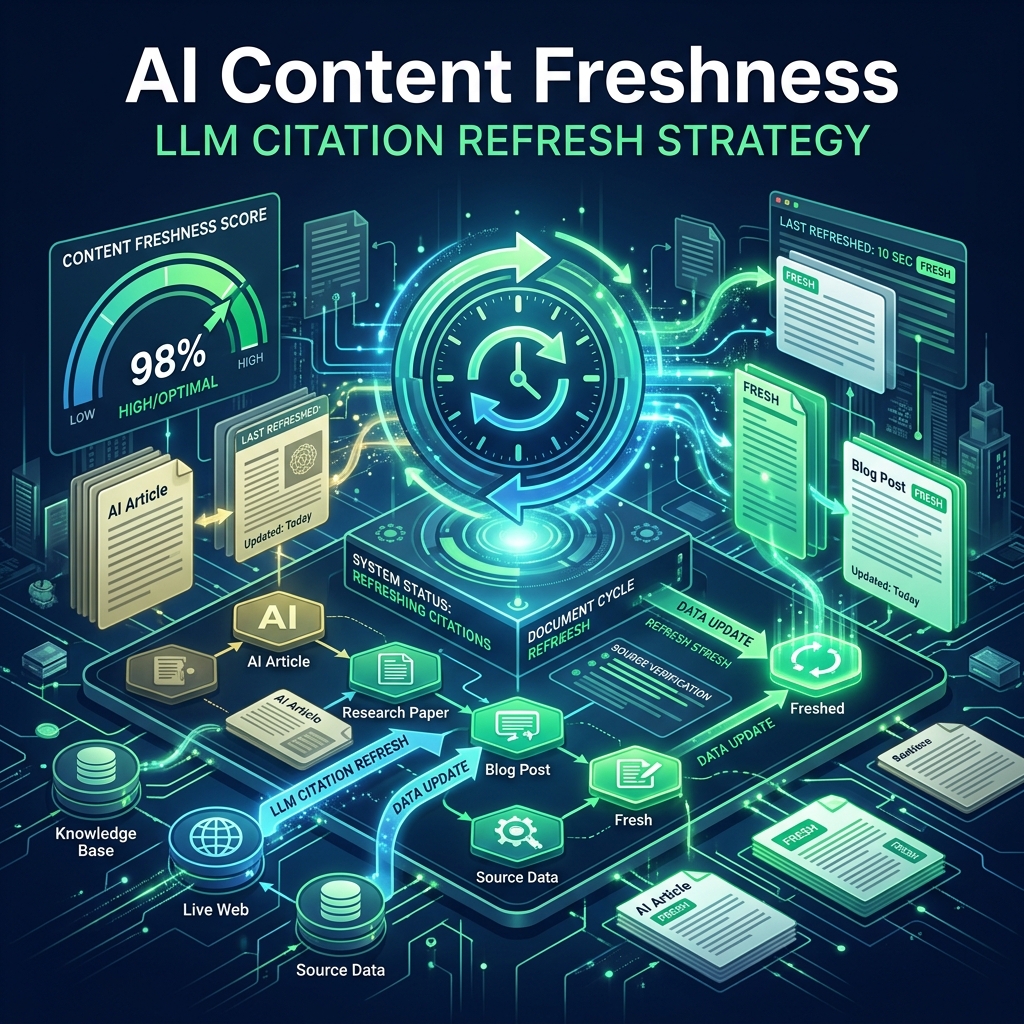
Content freshness is the discipline that prevents this. This guide explains how AI engines treat freshness differently from Google, the specific signals that indicate your content is losing relevance, and a low-effort refresh system that keeps your pages in the citation rotation.
How AI Engines Treat Freshness Differently
Google has always favored timely content, but it does so through mechanical proxies: publication dates, crawl frequency, and link velocity. AI engines inherit a different relationship with freshness because of how they are built.
Models are snapshot learners with continuing influence. An LLM is trained on data up to a cutoff, but its behavior on live search surfaces is influenced by retrieval: fresh, authoritative sources get pulled into answers regardless of training recency. Your competitiveness depends on being in that retrieved set, and retrieval preferences newer, more current sources for queries where recency matters.
Recency is topic-dependent. For a software review, a model prefers current information because features change. For a definition or a historical piece, older content is fine, and rewriting it can look like churn. Knowing which of your pages live in recency-sensitive topics is the first data point in a refresh strategy.
Structure decays as competitors improve. Worse than freshness loss is relativity loss. Even if your content is still accurate, a competitor who ships a better-structured, more extractable answer to the same query can displace you from citations. Keeping citations is a race in structure, not just accuracy.
The Signals That Your Content Is Losing Facetime
You do not need expensive tools to detect decay. Four signals tell you a page is falling out of the AI rotation:
Claims are dated. Your page says an outcome takes 60 days and the industry now quotes 30. Your stats cite last year. Your tool list is missing the current market leader. Every dated claim gives the model a reason to prefer a fresher source.
Your query no longer resolves to your answer. Ask your key AI engines your own target questions. If a page that used to be cited now goes unnamed, that is the clearest possible signal, and it costs nothing to check.
Your structure is thinner than the answer you lost to. The model rebuilt the answer from a competitor whose section is cleaner, whose bullets are tighter, or whose summary answers the question in the first paragraph. You were not beaten on facts; you were beaten on extractability.
Engagement flip indicators. If a page's clicks flatten or drop while impressions hold, real users are finding the answer outdated, and AI engines learn from similar behavioral signals. A lopsided impression-to-click ratio is worth auditing even when you cannot directly see citations.
A Refresh System That Costs Little
Treating every page as perpetually fragile is not sustainable, and it is not necessary. A small number of pages carry most of your citation value, and they are the ones worth a refresh cadence.
Step 1: Rank your pages by citation surface area. List your pages by how much AI-relevant value they hold: pages answering direct customer questions, pages that rank for the topics your brand owns, and pages competitors cite. The top twenty percent will deliver almost all your refresh value.
Step 2: Audit each high-value page quarterly. For each one, check three facts: are the claims still current, does the query still resolve to you, and is your structure still the cleanest answer available? That is a fifteen-minute audit per page, once a quarter.
Step 3: Refresh in place with heavy, truthful edits. Update the dated statistics, tighten the first paragraph into a quotable summary, rephrase headings as direct questions, and add any new subtopic your competitors now cover. Update the publication or review date so retrieval signals notice the change. A genuinely improved page is not churn; it is maintenance.
Step 4: New page, not refresh, when the topic split. If a query has split into two distinct intents since you wrote it, create a separate focused page rather than bloating the old one. Models prefer precise answers to sprawling ones.
Step 5: Track citation share, not just rankings. Run your key queries monthly and record which of your pages are named in AI answers. That number, and its trend, is the KPI that justifies both creating and updating content. It catches the loss that rankings never show.
Data-Driven Insights
1. Citation decay is faster than ranking decay. Observed refresh studies consistently show AI citation loss outpacing traditional ranking loss for the same pages. Pages that lose rankings usually lose citations weeks earlier, which makes citation share a leading indicator for your whole content investment.
2. Recency-sensitive topics dominate the refresh payoff. Software, tool, pricing, and tactics content sees the largest citation gains from refresh; evergreen definitional content sees near zero. Redirecting refresh effort to recency-sensitive pages concentrates the return.
3. Refresh compounding. Pages refreshed on a regular, honest cadence accumulate citation share across queries faster than pages refreshed in occasional feature pushes. The model learns to expect the page to be current, which strengthens every future retrieval.
FAQ
How do AI engines decide if content is fresh enough to cite?
For topics where recency matters, AI engines with retrieval prefer current sources and downgrade stale ones. The decision depends on the topic type, the visibility of the publication or site, and whether the page's claims still match what the model knows. Dated claims and superseded statistics both reduce a page's odds of citation.
How often should I refresh content for AI citations?
For your highest-value, recency-sensitive pages, audit quarterly and refresh when the audit finds dated claims, competitor structure wins, or query-resolution losses. Evergreen definitional content rarely needs refresh. Refresh in response to signals, not on a blind schedule.
What is the difference between refreshing and creating new content?
A refresh improves an existing page in place: updating claims, tightening structure, and revising the summary. New content is warranted when the query has split into distinct intents that the old page cannot serve cleanly. Refreshing should never mean ginning the same topic repeatedly.
Will frequently rewriting my content hurt my rankings?
Only if the rewrite weakens the page or looks like churn with no substance. A genuine refresh that updates facts and improves structure is treated by both Google and AI engines as a content improvement. Artificial rewordings that add no value can signal low quality to either system.
What metrics should I use to measure content freshness success?
Track AI citation share for your target queries monthly, alongside traditional rankings and engagement. A page that stays named in answers across queries while competitors churn is the outcome the freshness system exists to produce.
Conclusion
Content freshness for AI engines is not about writing more; it is about knowing which pages the models are about to drop. Rank your content by citation value, audit the top slice quarterly, refresh in place with honest updates, and measure citation share as the leading indicator it is. Google will show you a losing ranking months early; AI engines take that time away. The refresh system is the hedge.
Did you find this insightful?
Share this strategy with your network and help others stay ahead of the AI curve.
Browse more tactical guides →