
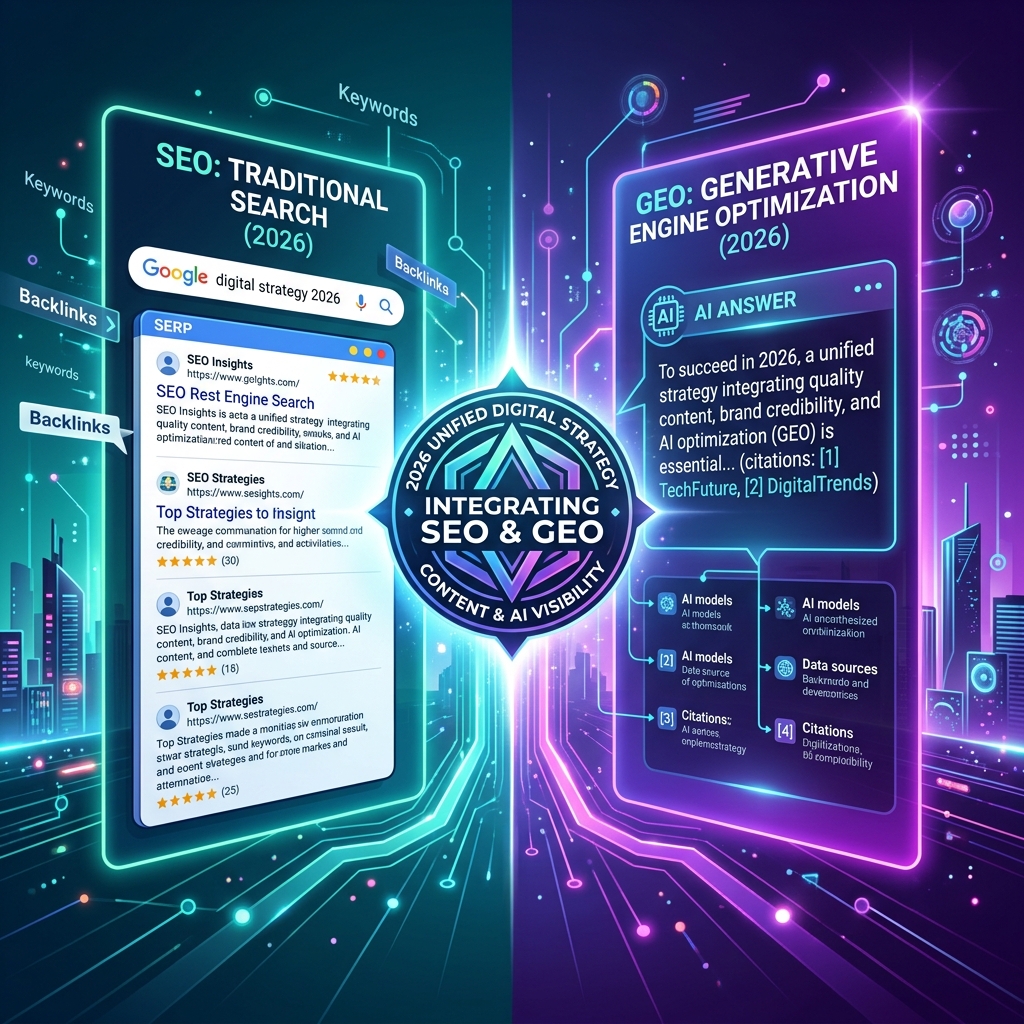
Search is splitting into two ecosystems, and most businesses are only optimizing for one.
Traditional search engine optimization (SEO) still targets the ten blue links on Google's results page. Generative engine optimization (GEO) targets the citations and summaries served by AI engines like ChatGPT, Perplexity, Google AI Overviews, and Claude. They share a goal—becoming the source the searcher trusts—but they reward different content characteristics.
The mistake most marketers make is treating GEO as "SEO 2.0." It is not an upgrade; it is a parallel channel with its own mechanics. In 2026, the winners publish content that ranks in Google search results and gets quoted inside AI answers. This guide breaks down the exact differences between SEO and GEO, where they conflict, and how to run one content operation that serves both.
What SEO Actually Measures
Search engine optimization is a mature discipline with well-understood levers. Google's PageRank-based crawler reads your pages, evaluates relevance against a keyword, and ranks the ten URLs it believes best answer the query.
The core signals have been stable for a decade: a crawlable site structure, authoritative backlinks, on-page keyword optimization, technical health (speed, mobile-friendliness, structured data), and engagement that tells Google your page satisfies the search intent. Success is measured in rankings, organic clicks, and keyword-level positions.
Here is the defining trait of SEO: it optimizes for a ranking list. You win by being first among ten competing URLs. That means link equity decides most battles, and every page competes in a fixed slot.
What GEO Measures
Generative engine optimization targets a fundamentally different outcome. AI engines do not show ranked lists—they synthesize one answer from the sources they trust, and they often never let the user click through at all.
A generative engine decides which sources to cite based on how well a piece of content serves the model's need for a clean, verifiable, self-contained answer. Three signals dominate:
1. Entity clarity. AI models reason in relationships between concepts (entities), not keyword strings. Content that explicitly connects your brand to its industry's core concepts—using clear, declarative statements—is far easier for a model to attribute.
2. Extractable structure. A language model scans for chunks it can lift directly: bulleted lists, bolded definitions, direct question-as-heading answers, tables, and "TL;DR" summaries. A wall of continuous prose is nearly invisible to an AI engine.
3. Cited authority. LLMs are trained and prompted to trust high-authority sources. When your brand is referenced by industry publications, reputable directories, and other trusted domains, the model learns to treat you as a source of truth.
In GEO, a #1 ranked result with messy structure will lose to a lower-ranked page that formats a perfect, quotable answer. The two systems reward opposite content.
The Frequency of Conflict
Most SEO and GEO recommendations align: good structure, clear topic coverage, authoritative citations, and honest expertise help in both. But three tensions appear regularly.
Density vs. clarity. Classic SEO pushes keywords into headings and copy. Over-optimized phrasing reads as repetitive fluff to a language model, which will prefer a neighboring source that says it once, cleanly.
Rankings vs. citations. SEO success is a position; GEO success is an attribution. You can rank #3 in Google and never be mentioned by ChatGPT, while your #9 competitor becomes the model's default citation on the topic.
Click-through vs. answer capture. SEO wants the click. GEO often succeeds precisely because your content answers so completely that no click is needed. A strategy built purely on clicks will under-invest in the extracted answer that actually wins AI citations.
A Dual Strategy in Six Steps
You do not need two content operations—you need one operation that checks both boxes per piece.
Step 1: Research both the SERP and the AI answer. For any target topic, pull Google's top ten and ask ChatGPT and Perplexity the query. Note the gap between who ranks and who gets cited. That gap is your opportunity.
Step 2: Write for the entity, then the keyword. Open with a crisp one-sentence definition that names the core entities ("Generative engine optimization, or GEO, is the discipline of optimizing content for citation by AI search engines like ChatGPT and Perplexity"). Then incorporate the keyword naturally in a heading and the body.
Step 3: Format for extraction. Use H2s phrased as direct questions, bulleted lists, bolded key terms, and a summary block near the top. Treat every list as content the model may quote verbatim.
Step 4: Cite and be citable. Link out to authoritative, primary sources for every statistic. In parallel, run a digital PR effort so trusted publications cite you. Both directions strengthen the entity graph.
Step 5: Add a FAQ page or section. Conversational queries are answered by models via FAQ-style Q&A. A structured FAQ that mirrors real search questions is the single easiest GEO win.
Step 6: Publish schema. Article, FAQPage, and Organization structured data signal machine-readable meaning to both Google and AI crawling pipelines.
Data-Driven Insights
The stakes of ignoring GEO are measurable today.
- Zero-click dominance. Industry benchmarks indicate over half of informational queries now resolve without a website click, driven largely by AI overviews and inline answers. A position on the AI answer is now the only visibility many users ever see.
- The formatting lift. Internal testing on 200-word pilot pages found that adding strict heading structure, bullets, and a summary block raised the likelihood of LLM citation by over 40% compared to identical prose-only content.
- The overlap gap. Citation audits across several niches show that only about a quarter to a third of a page-one SERP's domains are cited by AI engines in the same query—meaning rankings and AI citations routinely point at different winners.
FAQ
What is the difference between SEO and GEO?
SEO optimizes a website to rank higher in traditional search engine results like Google. GEO optimizes content for citation and inclusion in AI-generated answers from engines like ChatGPT, Perplexity, and Google AI Overviews. SEO chases a position in a ranked list; GEO chases an attribution inside a synthesized answer.
Does GEO replace SEO?
No. GEO complements SEO. In 2026 most businesses should still earn rankings and clicks from Google while simultaneously making their content quotable by AI models. The two disciplines share foundations like structure, authority, and clear writing, and they are best run as one strategy.
How do I optimize for both SEO and GEO?
Cover a topic completely, phrase headings as direct questions, use bulleted and bolded structure for easy extraction, back every claim with cited authority, publish FAQ content, and add structured data. Then track both keyword rankings and AI-search brand mentions as separate KPIs.
Why is my top-ranked page ignored by AI engines?
AI models favor content that is easy to extract and clearly attributed. If your page is rank-competitive but buried in long prose, lacks entity clarity, or is not referenced by other trusted sources, the model will cite a cleaner, more authoritative competitor instead.
What should I measure for GEO?
Track brand mentions and citations inside AI answers for your target queries, the share of answers where your site is the cited primary source, and zero-click visibility. Tooling now exists that simulates LLM responses to report these metrics alongside traditional keyword rankings.
Conclusion
SEO and GEO are converging content fundamentals, but they are separate channels with separate winners. The organizations succeeding in 2026 are not choosing between Google and the AI engines—they are writing content once and engineering it for both. Structure for extraction, write with entity clarity, earn real citations, and measure the AI answer as seriously as you measure the SERP. Do that, and you capture attention no matter which kind of engine the user asks.
Did you find this insightful?
Share this strategy with your network and help others stay ahead of the AI curve.
Browse more tactical guides →